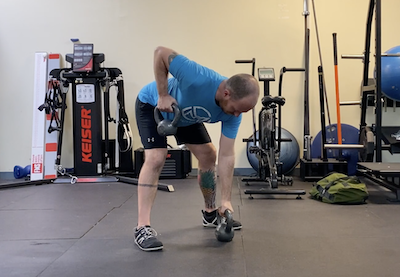
Renegade Row
Renegade rows are a hybrid strength and stability movement that target the back, shoulders, arms, and core. Performed from a high plank position while rowing a dumbbell, this exercise challenges your ability to stay balanced and resist rotation—making it a favorite for functional strength training.
Renegade rows are particularly effective at improving anti-rotation core control, scapular stability, and upper body pulling strength. Because they require full-body tension to stay stable while moving one arm at a time, they’re ideal for athletes and lifters looking to reinforce control and power in asymmetrical positions.
This movement is typically used in strength circuits, full-body training sessions, or as a core finisher to build control under tension.
Renegade rows are an efficient and effective way to train pulling strength and anti-rotation stability at the same time. Add them to your program to build a strong, stable upper body and core.
Equipment Needed:
-
Pair of dumbbells (hex-shaped preferred)
-
Flat floor or mat
How to Perform Renegade Rows:
-
Start in a high plank position with a dumbbell in each hand, feet set wider than shoulder-width for balance.
-
Engage your core and keep your body in a straight line from head to heels.
-
Shift your weight slightly and row one dumbbell toward your rib cage, keeping your elbow close.
-
Lower the dumbbell with control and repeat on the other side.
-
Alternate sides for the desired number of reps.
Common Renegade Row Mistakes:
-
Rotating the hips or twisting through the torso
-
Shrugging the shoulders or flaring the elbows
-
Letting the lower back sag or hips drop
-
Rushing the reps and sacrificing control
Renegade Row Progressions and Regressions:
If this exercise is too challenging:
-
Perform the rows from knees in a modified plank position
-
Use lighter dumbbells
-
Start with slow controlled rows without weight to build balance
If you want to increase the challenge:
-
Add a push-up between rows
-
Narrow the foot stance for less stability
-
Use heavier dumbbells or increase tempo under control